Confidential client records, crisis accommodation rostering, and safety-first record keeping — one platform for Australian domestic and family violence services, at one flat weekly rate.
Most DFV services run on a patchwork of spreadsheets, paper files, shared inboxes, and personal phones. That patchwork creates risk — for clients, for staff, and for the service.
Real features, mapped to the work of crisis accommodation, outreach, and case management teams.
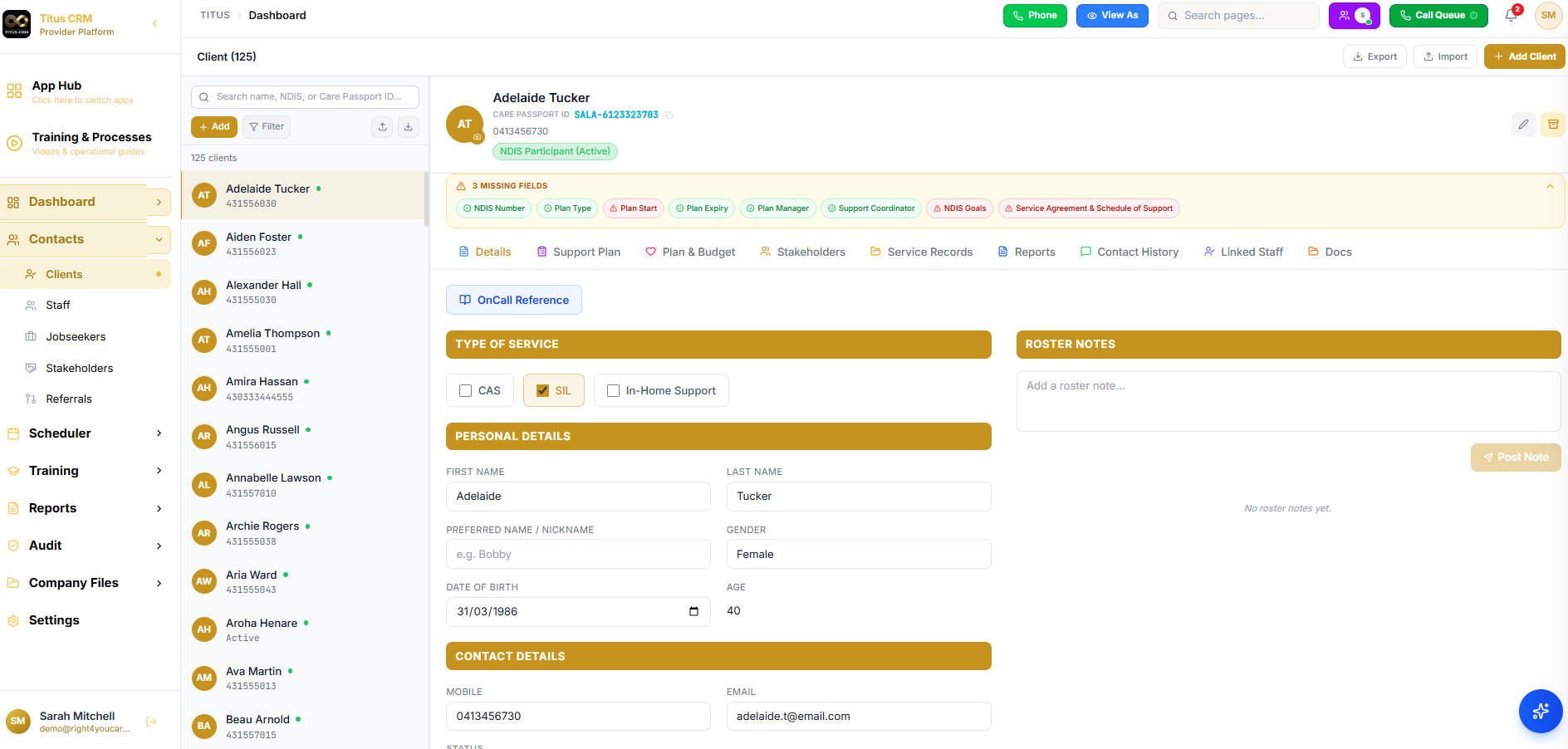
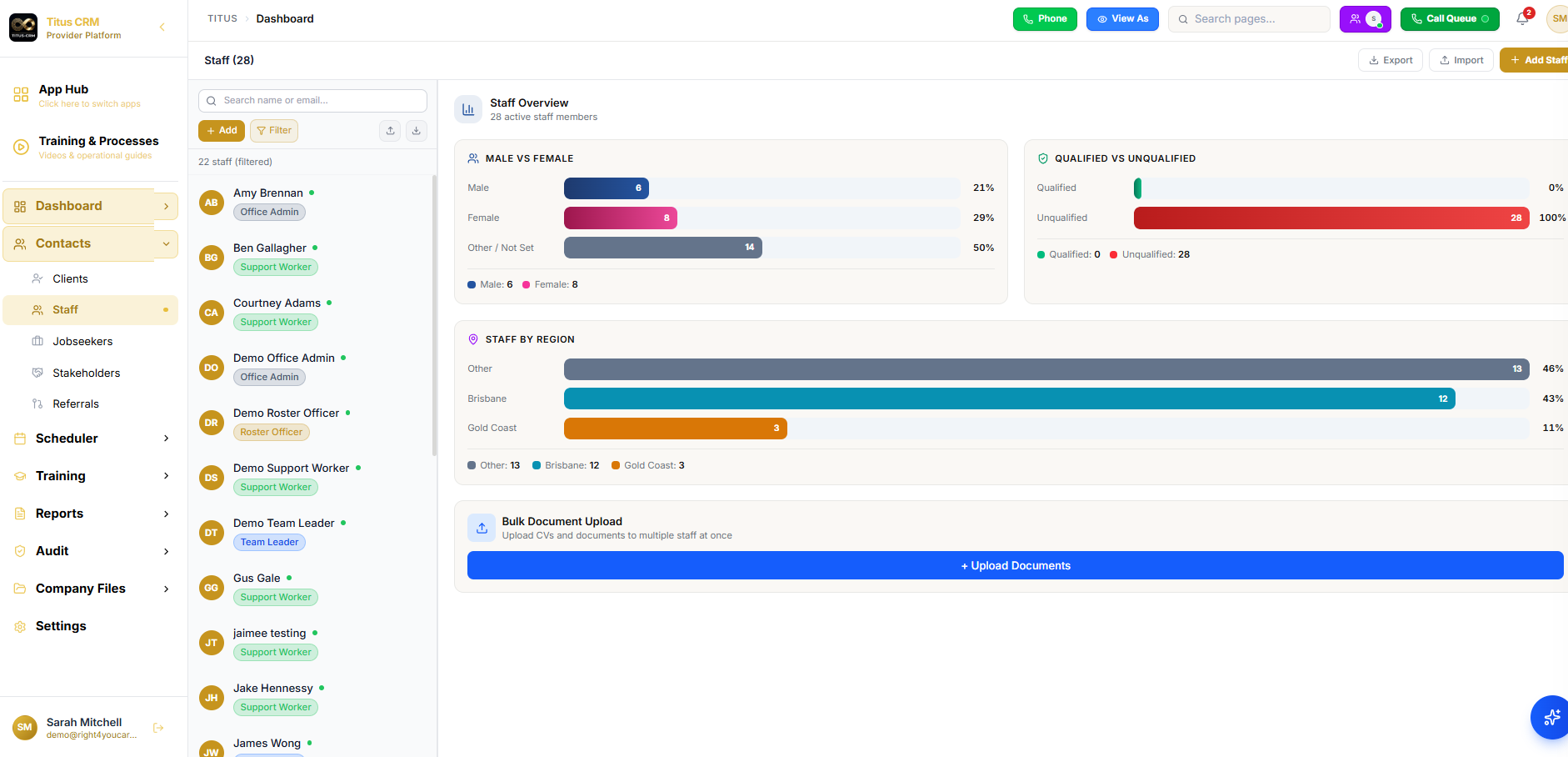
Client information in a DFV service is sensitive by definition. In Titus, access is controlled by role — your administrators decide who sees what, and every record stays scoped to your organisation.
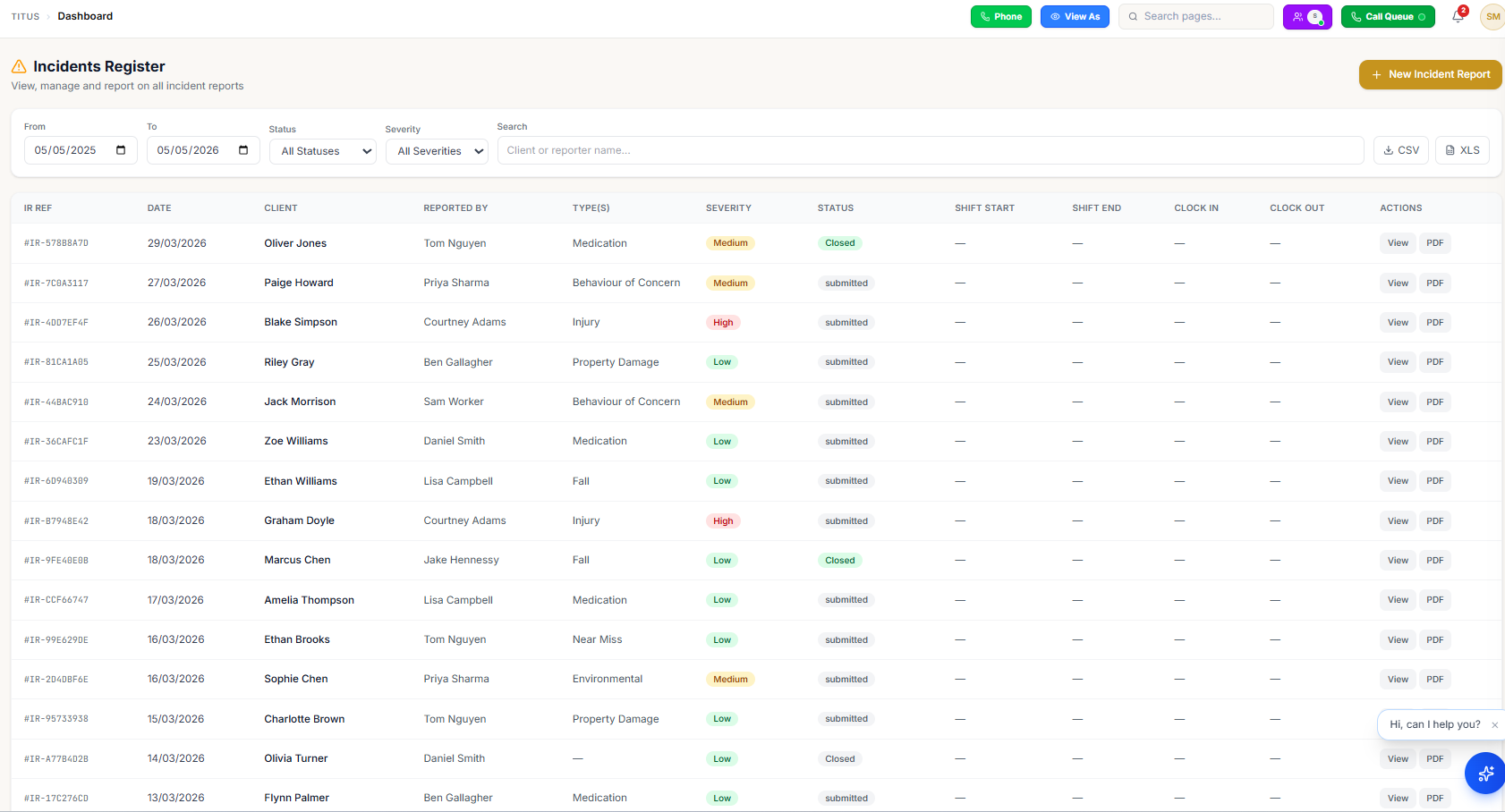
Consistent, defensible documentation matters when your records may be relied on by courts, police, or child protection. Titus gives every worker the same structure for notes and incidents — in one place, not six.
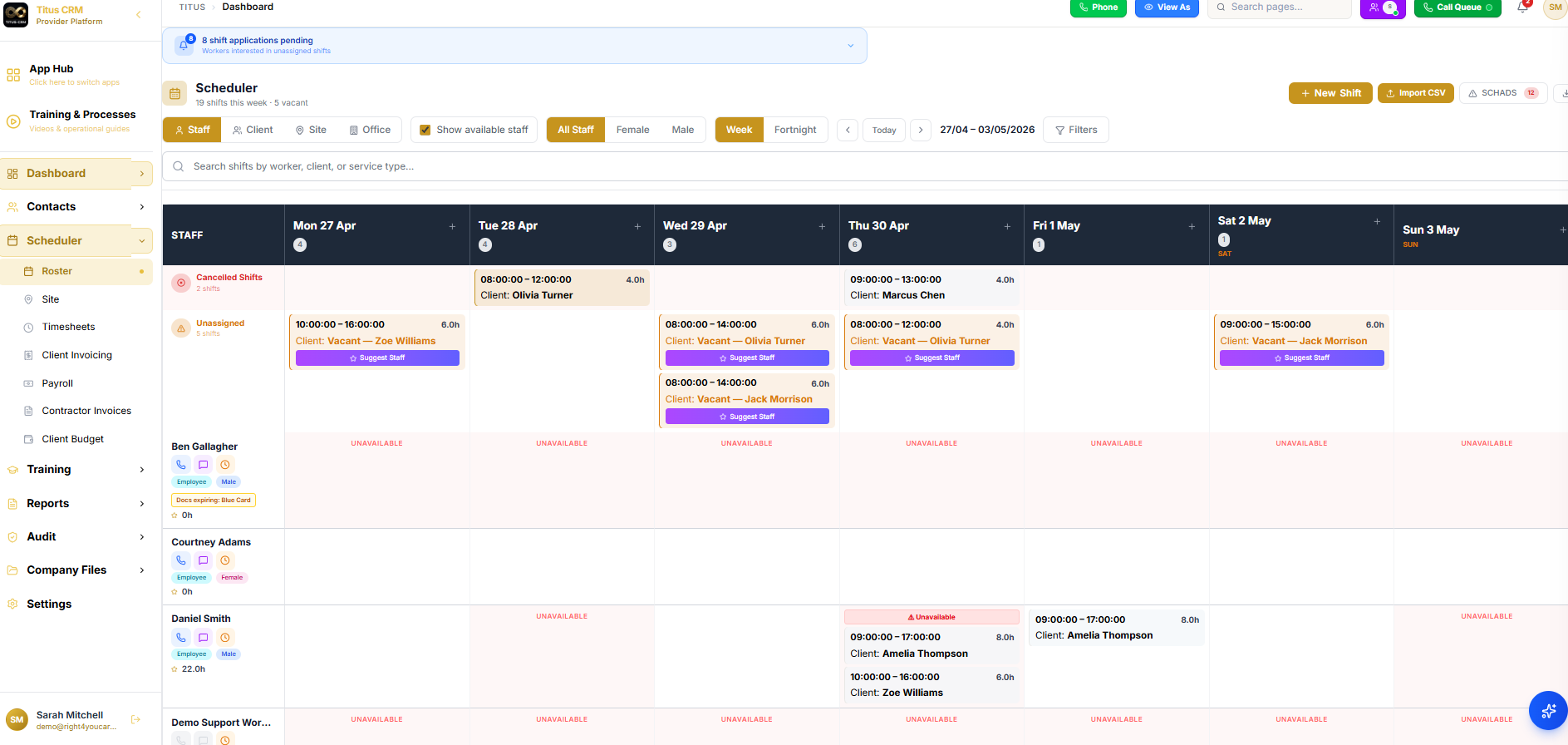
Refuges and crisis accommodation never close. Titus rostering handles round-the-clock rotations, overnight and sleepover shifts, and multiple sites — and checks every shift against SCHADS Award rules before it's worked.
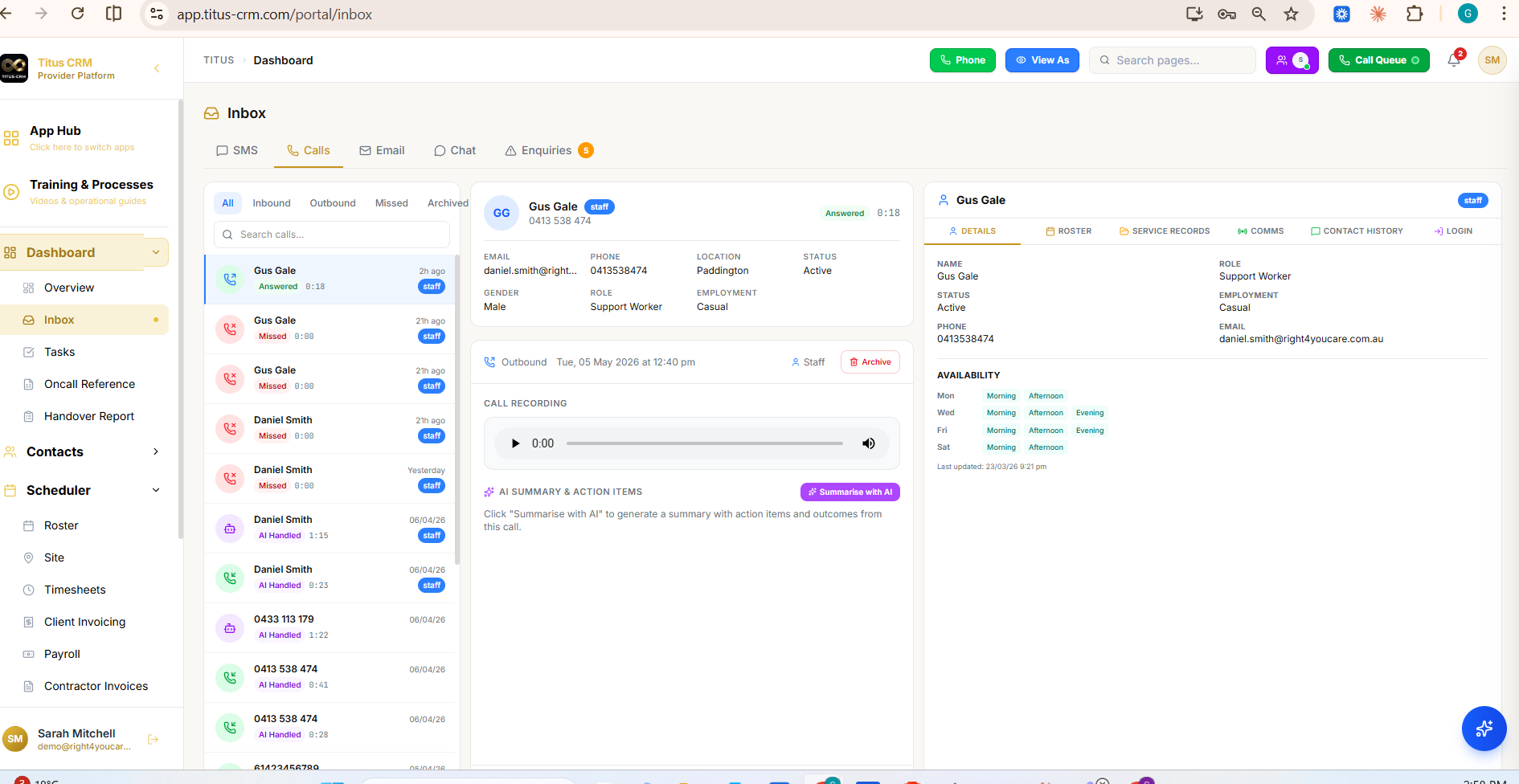
When someone reaches out to your service, that first contact matters — and so does the record of it. Titus brings calls, SMS, and email into one inbox, with AI transcription so nothing said on an intake or on-call line is lost.
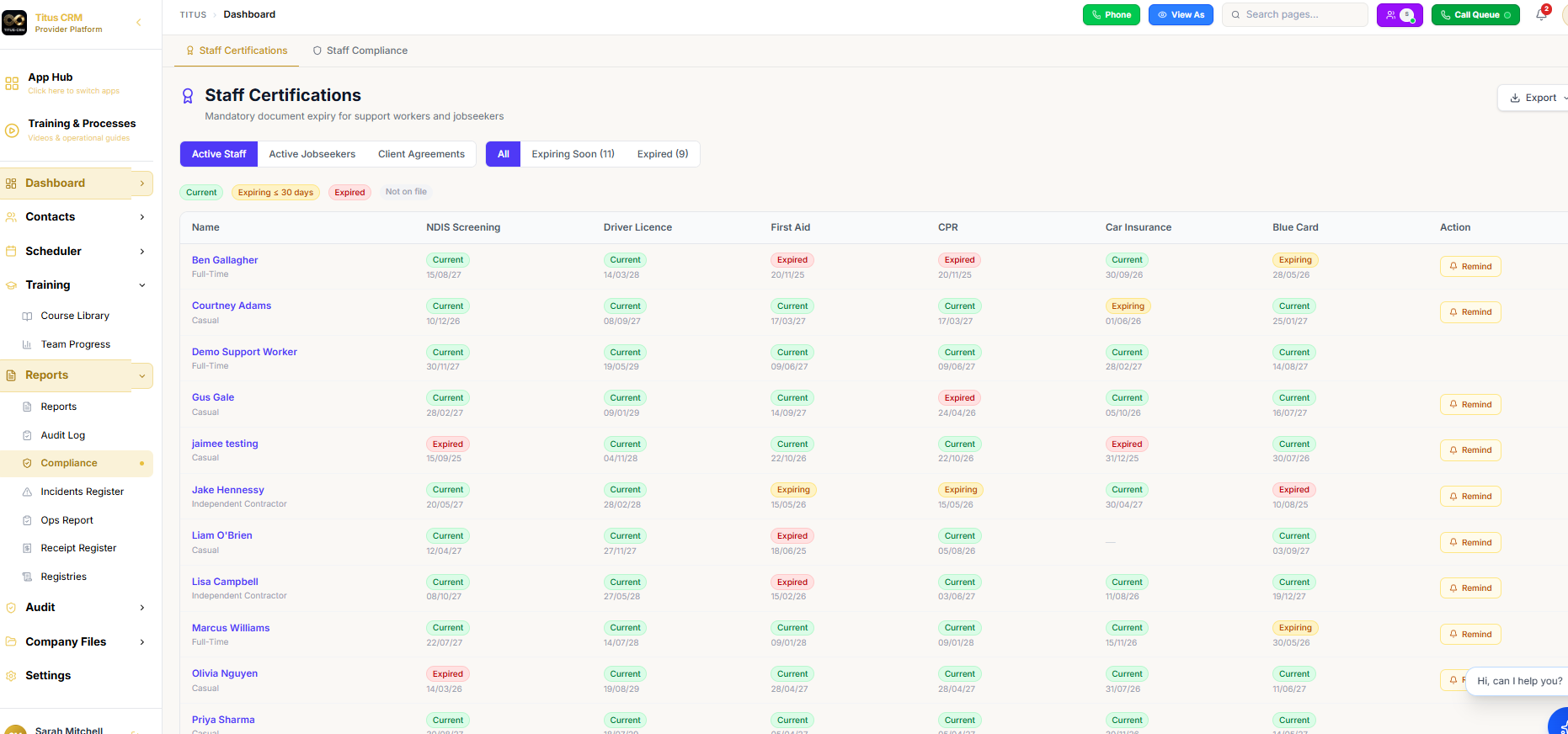
Your workers hold checks and qualifications that expire. Titus tracks them all with expiry alerts, and its built-in Learning Management System delivers and evidences staff training — so onboarding and refreshers don't rely on memory.
We won't hand-wave about security. Here is plainly how client information is protected in Titus: access is decided by role, every record is scoped to your organisation, every entry is attributable, and your data lives in Australia.
Titus supports domestic and family violence organisations across accommodation, outreach, and case management.
Staffing properties around the clock, managing sleepover and overnight shifts, and keeping resident records confidential across sites — with SCHADS checked before payroll, not after.
Workers in the community need case notes, contact history, and schedules from any device — in a system where access follows the worker's role, not a shared login.
Structured case notes, consistent incident recording, and reporting for funders — the documentation discipline your service is accountable for, without the spreadsheet sprawl.
A built-in phone system with transcription means after-hours and intake calls are captured, summarised, and attached to the record — not lost on a personal mobile.
Running DFV services alongside NDIS, aged care, or youth programs? Titus serves the full human-services stack, so one platform can carry more than one program.
Ready to move off spreadsheets without a heavyweight enterprise rollout. Rent Titus and growing your team never grows your software bill — and when you're ready, own it outright from $6,500.
No lengthy implementations. Most organisations are live within a week.
30 minutes with our team. We'll walk through the platform against how your service actually operates, and answer every question.
21 days, full access, no credit card needed. Set up roles and access permissions before any client data goes in.
Dedicated onboarding support to configure Titus for your organisation and train your staff. Migrating data from your existing system is quoted separately.
Rent at a weekly fee that doesn't move as you hire — or own your platform outright from $6,500 with no ongoing fee. Either way, your cost stays predictable.
Per-user software penalises services for growing their team. Titus gives you three ways in — rent the complete platform as one flat weekly fee that never climbs as you hire, step up as you grow, or own a branded platform of your own outright. Predictable pricing built for funded services, whether you roster 12 workers or 90.
No credit card required. No lock-in contract. Cancel anytime.
Step up to Rent Titus — up to 300 contacts and 100 clients for $249/week. Same system, more headroom, no renegotiation.
No credit card required. No lock-in contract. Cancel anytime.
Rent you pay in your first 8 weeks comes straight off the price of owning your platform — try it in your real service, then own it.
30% deposit starts the build · balance on delivery. Add-ons (one-off): AI Brain +$1,499 · Unified Inbox +$1,999 · 24/7 AI Voice Receptionist +$399. Fully loaded (all three add-ons): $10,397 +GST.
Per-user software means every new worker adds to your software bill — hard to budget on grant funding cycles. Renting Titus is one flat weekly fee with every module and a built-in phone system included, so the cost you put in this year's budget is the cost you'll pay when your team is bigger next year. And when you're ready to stop renting, you can own it outright from $6,500 with no ongoing fee.
What domestic and family violence services ask before moving to Titus.
Titus CRM is a case management platform built for Australian care providers, including domestic and family violence services. It combines confidential client records with role-based access, case notes, an incident register, 24/7 rostering for crisis accommodation, staff screening tracking, intake call transcription, SCHADS-compliant timesheets, and funder reporting in one platform. Rent it as a flat weekly subscription — not per user — or own it outright as a one-off branded build.
Titus CRM controls access to client records with role-based permissions, so staff only see the clients and record types their role allows. Every record is scoped to your organisation using database row-level security, entries are timestamped and attributed to the staff member who wrote them, and client records are stored in an Australian (Sydney) database region. Access is managed by your administrators, not shared logins. See our privacy policy for full data-handling details.
Yes. Titus CRM's rostering module is built for 24/7 services. It handles round-the-clock rotations, sleepover and overnight shifts, on-call arrangements, and multiple sites, and checks every shift against SCHADS Award rules in real time — flagging overtime, minimum engagement, and penalty rates before they become payroll problems. Staff check in against shifts and managers approve timesheets in the same system.
Yes. Titus CRM includes a built-in phone system with a unified inbox for calls, SMS, and email, so intake enquiries and after-hours calls land in one place instead of a personal mobile. Calls can be transcribed and summarised by AI, and the full contact history stays attached to the client record — visible only to staff whose role permits it.
Titus CRM gives DFV services three ways in. Rent it as one flat weekly fee — Startup Rent is $169/week for up to 100 contacts and 50 clients, and Rent Titus is $249/week for up to 300 contacts and 100 clients. Or own it outright with a one-off branded build from $6,500, delivered in 30 days with no subscription. Every option includes the full platform. There are no lock-in contracts on the rent tiers, billing is weekly, and the price is not per user, so it never climbs as you hire more staff — predictable on grant funding cycles.
Yes. Most Australian DFV service staff are employed under the SCHADS Award, and Titus CRM checks rosters and timesheets against SCHADS rules in real time — including minimum engagement periods, overtime, broken shifts, sleepover provisions, and weekend and public holiday penalty rates — before shifts are worked, not after payroll runs.
Yes. Titus CRM offers a 21-day free trial with full access to every module and no credit card required. Most organisations are operational within a week — Titus includes onboarding support to configure roles and access permissions and train your team. Migrating client and staff data from your existing system is quoted separately, based on data volume and source system. Any changes or additions to the product beyond standard configuration are also quoted separately, based on the amount of work required.
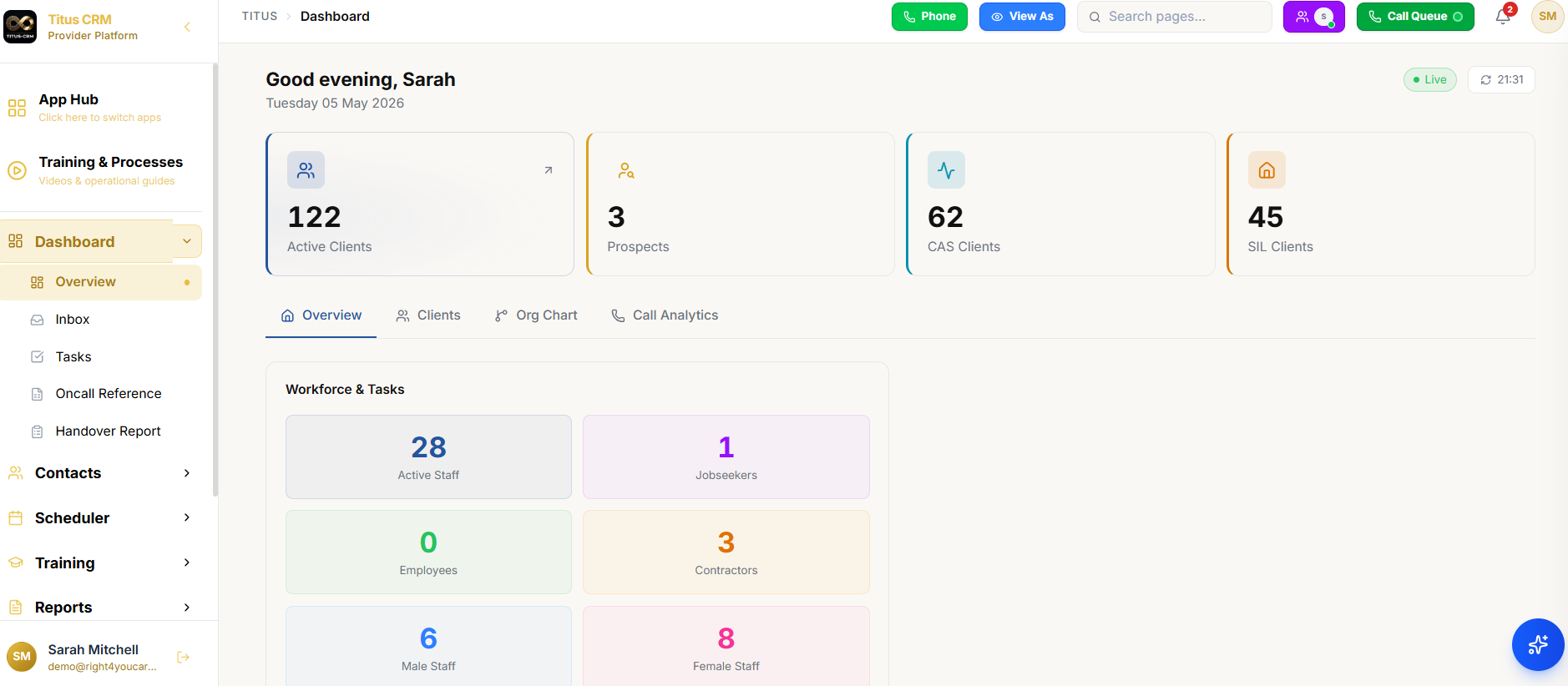
Book a 30-minute demo. We'll walk through confidentiality settings, rostering, and reporting against how your organisation actually works — no pressure, no obligation.